
Prince2-Practitioner Exam Dumps - PRINCE2 7 Practitioner (7th Edition) Exam
Searching for workable clues to ace the PRINCE2 Prince2-Practitioner Exam? You’re on the right place! ExamCert has realistic, trusted and authentic exam prep tools to help you achieve your desired credential. ExamCert’s Prince2-Practitioner PDF Study Guide, Testing Engine and Exam Dumps follow a reliable exam preparation strategy, providing you the most relevant and updated study material that is crafted in an easy to learn format of questions and answers. ExamCert’s study tools aim at simplifying all complex and confusing concepts of the exam and introduce you to the real exam scenario and practice it with the help of its testing engine and real exam dumps
Scenario
Additional Information
During the initiation stage the Project Manager met with the Marketing Director to find out more about the requirements of the promotional calendar and recorded the following notes:
There has been a reduction in the order numbers at the MNO Manufacturing due in part to the increased marketing activities of its competitors. 10% of customers have not re-ordered in this financial year and staff morale is poor. A number of skilled staff have left as a result and replacement staff have not been recruited due to the reduced operation. If the project is successful, a recruitment campaign will be required to fill the existing staff vacancies and there may be a requirement for additional staff. Operational costs are likely to increase because skilled staff are expensive and difficult to find.
In financial terms, there were a total of 1,500 orders in the last financial year, each with an average profit of £2k. The Marketing department believes that sending a promotional calendar to our current and prospective customers would increase orders by at least 10% with a minimum of 10 further orders from the list of prospective customers within 12 months from the date of distribution.
The Marketing Director will be funding the project from the business marketing budget. She believes that the effect of a good company image portrayed by a successful calendar would last into a second year. She has forecast the same increase in orders for a second year and predicts that the annual employee satisfaction survey will show a measurable improvement in staff morale.
A number of alternatives were explored, including:
20% discount for all repeat customers - not cost-effective and very short term
A promotional calendar as a free Christmas gift - would target current and prospective customers and the benefits would last into a second year
A series of television and press advertisements was too expensive
A direct mail shot to all customers - benefit would be short term
Creation of an internet website - would not suit all customers
The calendar is seen as the favored option, as long as the company's competitors do not increase their marketing activity. Whilst the Marketing department wants a very high quality, glossy product, the project management team must be aware of the cost this will incur.
Using the Project Scenario and the additional Information provided for this question In the Scenario Booklet, answer the following question.
Which 2 statements should be recorded under the Expected benefits heading?
Scenario
A central government department, the Ministry of Food Hygiene (MFH), faces increasing pressure to cut costs, better manage suppliers’ performance and reduce the confusion caused by inadequate internal controls, outdated standards and outdated technology. External consultants were employed to conduct a feasibility study to identify options to address the problems, and the likely costs and benefits. The following options were considered:
â— Do nothing.
â— Re-engineer selected business functions.
â— Outsource selected business functions.
The feasibility study concluded that there was a case for outsourcing the MFH Information Technology
Division and the Facilities Division (maintenance of buildings and grounds). The recommendations were:
â— One service provider should be contracted to provide the services currently provided by the
Information Technology Division and the Facilities Division.
â— A 10-year service contract should be agreed with the selected service provider.
The feasibility study developed high-level designs of the current organization, processes, systems and
operating models, plus an outline Business Case for the required project. The external consultants
also made the following recommendations for the management of the project:
â— Use PRINCE2.
â— Set up the project with 4 management stages:
Stage 1. Standard PRINCE2 initiation activities.
Stage 2. Create detailed designs (future organization, processes, systems and operating
models) and the service level agreement between MFH and the future service
provider.
Stage 3. Request and evaluate proposals, select service provider and agree contract.
Stage 4. Transfer equipment and staff, transfer responsibility for service provision and run
trial period.
Initial estimates indicated that the project would cost £2.5m and take two years to complete.
MFH senior management agreed that there was a case for outsourcing, and accepted the
recommendations as a basis for the project. There is an expected saving of £20m over 10 years.
The Outsourcing project has completed the Starting up a Project process and is now in the initiation stage. Because of the strategic importance of the project, the MFH Chief Executive Officer has taken the role of Executive. A PRINCE2-experienced Project Manager has been appointed from within MFH. Staff within the business functions being outsourced will work with the external consultants who conducted the feasibility study to define the detailed designs.
Which 2 statements should be recorded under the Reasons heading?
Scenario
A central government department, the Ministry of Food Hygiene (MFH), faces increasing pressure to cut costs, better manage suppliers’ performance and reduce the confusion caused by inadequate internal controls, outdated standards and outdated technology. External consultants were employed to conduct a feasibility study to identify options to address the problems, and the likely costs and benefits. The following options were considered:
â— Do nothing.
â— Re-engineer selected business functions.
â— Outsource selected business functions.
The feasibility study concluded that there was a case for outsourcing the MFH Information Technology Division and the Facilities Division (maintenance of buildings and grounds). The recommendations were:
â— One service provider should be contracted to provide the services currently provided by the Information Technology Division and the Facilities Division.
â— A 10-year service contract should be agreed with the selected service provider.
The feasibility study developed high-level designs of the current organization, processes, systems and operating models, plus an outline Business Case for the required project. The external consultants also made the following recommendations for the management of the project:
â— Use PRINCE2.
â— Set up the project with 4 management stages:
Stage 1. Standard PRINCE2 initiation activities.
Stage 2. Create detailed designs (future organization, processes, systems and operating models) and the service level agreement between MFH and the future service provider.
Stage 3. Request and evaluate proposals, select service provider and agree contract.
Stage 4. Transfer equipment and staff, transfer responsibility for service provision and run trial period.
Initial estimates indicated that the project would cost £2.5m and take two years to complete.
MFH senior management agreed that there was a case for outsourcing, and accepted the recommendations as a basis for the project. There is an expected saving of £20m over 10 years.
The Outsourcing project has completed the Starting up a Project process and is now in the initiation stage. Because of the strategic importance of the project, the MFH Chief Executive Officer has taken the role of Executive. A PRINCE2-experienced Project Manager has been appointed from within MFH. Staff within the business functions being outsourced will work with the external consultants who conducted the feasibility study to define the detailed designs.
Which 2 statements should be recorded under the Major risks heading?
Scenario
Additional Information
During the initiation stage the Project Manager met with the Marketing Director to find out more about the requirements of the promotional calendar and recorded the following notes:
There has been a reduction in the order numbers at the MNO Manufacturing due in part to the increased marketing activities of its competitors. 10% of customers have not re-ordered in this financial year and staff morale is poor. A number of skilled staff have left as a result and replacement staff have not been recruited due to the reduced operation. If the project is successful, a recruitment campaign will be required to fill the existing staff vacancies and there may be a requirement for additional staff. Operational costs are likely to increase because skilled staff are expensive and difficult to find.
In financial terms, there were a total of 1,500 orders in the last financial year, each with an average profit of £2k. The Marketing department believes that sending a promotional calendar to our current and prospective customers would increase orders by at least 10% with a minimum of 10 further orders from the list of prospective customers within 12 months from the date of distribution.
The Marketing Director will be funding the project from the business marketing budget. She believes that the effect of a good company image portrayed by a successful calendar would last into a second year. She has forecast the same increase in orders for a second year and predicts that the annual employee satisfaction survey will show a measurable improvement in staff morale.
A number of alternatives were explored, including:
20% discount for all repeat customers - not cost-effective and very short term
A promotional calendar as a free Christmas gift - would target current and prospective customers and the benefits would last into a second year
A series of television and press advertisements was too expensive
A direct mail shot to all customers - benefit would be short term
Creation of an internet website - would not suit all customers
The calendar is seen as the favored option, as long as the company's competitors do not increase their marketing activity. Whilst the Marketing department wants a very high quality, glossy product, the project management team must be aware of the cost this will incur.
Using the Project Scenario and the additional Information provided for this question In the Scenario Booklet, answer the following question.
Which 2 statements correctly define a Business Case risk which should be recorded under the Major risks heading?
A quality specification states: “The shopping centre will provide leisure and restroom space of a minimum of 2000.â€
Is this an appropriate application of the quality practice, and why?
BUSINESS CASE
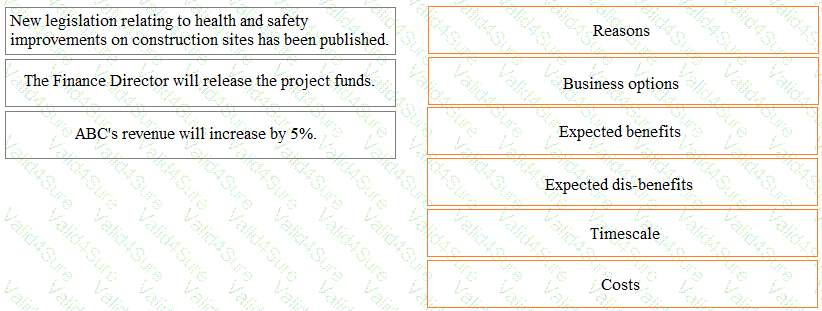
Here are three statements from the business case for the Health and Safety Project.
Under which heading in the business case (A-F) should they be recorded?
Choose only one heading for each statement. Each heading can be used once, more than once, or not at all.
During the 'create the project plan' activity as part of the initiation stage, the project manager identifies several threats to the project timescales. These threats relate to stage 3 products. Therefore, the project manager decides to wait until the end of stage 2 to assess the risks to the project plan.
Is this an appropriate application of the plans theme, and why?
Project Scenario – Health and Safety Training Project:
ABC Company is a well-established training company that uses a standard model to develop training materials and deliver courses to customers.
ABC Company has commissioned a project in response to recent changes in government legislation relating to health and safety on construction sites. The project will deliver “capability to provide health and safety trainingâ€, including the materials needed for classroom-based training and e-learning. The expected benefits for construction companies include a reduction in lost days and legal costs due to accidents.
The e-learning course will be developed by a specialist external consultancy. The materials for classroom-based training will be delivered by ABC Company’s development team. All course materials will be piloted before they are used. ABC Company will deliver training to its customers and also hopes to sell the course materials to other training companies as part of their operational business. ABC Company will use their own sales and marketing departments to promote the courses.
The legislation requires construction companies to comply with the new legislation within two years. The course materials and trainers have to be accredited by a government agency before courses can be delivered. ABC Company is planning to deliver pilot courses within five months of starting the project.
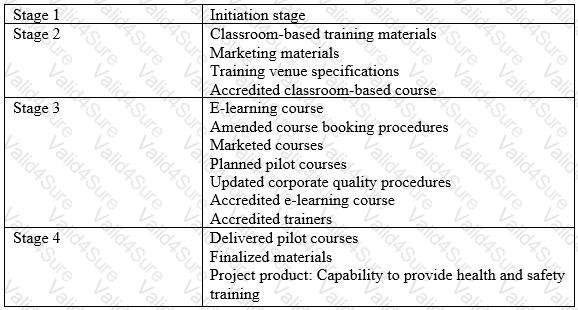
The ABC Company standard development model for new courses recommends the following stages:
End of the Project scenario.
Additional Information:
The Chief Executive Officer (CEO) founded the company five years ago. Under her leadership, ABC Company has grown quickly into a successful training company. It delivers a range of accredited professional training.
The Finance Director is also a founder member of ABC Company and is responsible for authorizing budgets for the Operations and Development Teams. She authorizes all large contracts personally.
The Purchasing Manager reports to the Finance Director and is responsible for managing and monitoring supplier contracts.
The Operations Director is responsible for the delivery off all training and for the training development budget. His department organizes courses, venues and trainers. They work with the Product and the Sales teams to provide a comprehensive training schedule. ABC Company’s IT manager reports to the Operations Director.
The Business Development Director has recently been appointed to identify new training needs and propose new products. She will work with the Operations. Director to ensure a cost-conscious approach and that appropriate development technologies are used for the health and safety course.
The Training Development Manager reports to the Business Development Director and is responsible for developing training materials and gaining accreditation, in accordance with the standard course development model. Course developers in his team have skills in a range of development technologies and are allocated to projects as needed.
The Training Delivery Manager, who reports to the Operations Director, is responsible for ensuring that internal and external trainers deliver ABC Company training courses to the required standard. He also checks course materials to ensure they are fit for purpose and of the required quality.
The Central Services Director has responsibility for corporate communications, facilities management and configuration management. He recently led a project to consolidate all company quality systems into one quality management system and set up a corporate quality department, now managed by the Corporate Quality Manager.
The Corporate Document Manager reports to the Central Services Director. She helped establish the company’s document management system and now operates it across the business. She manages a team of administrators and contracts staff when workload is high.
The Sales Director joined ABC Company two months ago and is keen to establish himself by suggesting new markets for the courses and material. All account managers and the marketing team report to him. They promote existing training courses to other training companies and existing customers.
End of the additional information.
During stage 3, a work package was assigned to produce the 'planned pilot courses'. The product's quality criteria were defined and baselined before the work package was agreed.
Which principle is being applied, and why?