
Spring Sale Special Limited Time 70% Discount Offer - Ends in 0d 00h 00m 00s - Coupon code: scxmas70

Professional-Machine-Learning-Engineer Exam Dumps - Google Professional Machine Learning Engineer

Searching for workable clues to ace the Google Professional-Machine-Learning-Engineer Exam? You’re on the right place! ExamCert has realistic, trusted and authentic exam prep tools to help you achieve your desired credential. ExamCert’s Professional-Machine-Learning-Engineer PDF Study Guide, Testing Engine and Exam Dumps follow a reliable exam preparation strategy, providing you the most relevant and updated study material that is crafted in an easy to learn format of questions and answers. ExamCert’s study tools aim at simplifying all complex and confusing concepts of the exam and introduce you to the real exam scenario and practice it with the help of its testing engine and real exam dumps

Go to page:
Question # 33

You are responsible for managing and monitoring a Vertex AI model that is deployed in production. You want to automatically retrain the model when its performance deteriorates. What should you do?

A.

Use Vertex Explainable AI to analyze feature attributions and identify potential biases in the model. Retrain when significant shifts in feature importance or biases are detected.

B.

Collect feedback from end users, and retrain the model based on their assessment of its performance.

C.

Create a Vertex AI Model Monitoring job to track the model ' s performance with production data, and trigger retraining when specific metrics drop below predefined thresholds.

D.

Configure a scheduled job to evaluate the model ' s performance on a static dataset, and retrain the model if the performance drops below predefined thresholds.

Full Access
Question # 34

You developed a Vertex Al ML pipeline that consists of preprocessing and training steps and each set of steps runs on a separate custom Docker image Your organization uses GitHub and GitHub Actions as CI/CD to run unit and integration tests You need to automate the model retraining workflow so that it can be initiated both manually and when a new version of the code is merged in the main branch You want to minimize the steps required to build the workflow while also allowing for maximum flexibility How should you configure the CI/CD workflow?

A.

Trigger a Cloud Build workflow to run tests build custom Docker images, push the images to Artifact Registry and launch the pipeline in Vertex Al Pipelines.

B.

Trigger GitHub Actions to run the tests launch a job on Cloud Run to build custom Docker images push the images to Artifact Registry and launch the pipeline in Vertex Al Pipelines.

C.

Trigger GitHub Actions to run the tests build custom Docker images push the images to Artifact Registry, and launch the pipeline in Vertex Al Pipelines.

D.

Trigger GitHub Actions to run the tests launch a Cloud Build workflow to build custom Dicker images, push the images to Artifact Registry, and launch the pipeline in Vertex Al Pipelines.

Full Access
Question # 35

You work for an online retail company that is creating a visual search engine. You have set up an end-to-end ML pipeline on Google Cloud to classify whether an image contains your company ' s product. Expecting the release of new products in the near future, you configured a retraining functionality in the pipeline so that new data can be fed into your ML models. You also want to use Al Platform ' s continuous evaluation service to ensure that the models have high accuracy on your test data set. What should you do?

A.

Keep the original test dataset unchanged even if newer products are incorporated into retraining

B.

Extend your test dataset with images of the newer products when they are introduced to retraining

C.

Replace your test dataset with images of the newer products when they are introduced to retraining.

D.

Update your test dataset with images of the newer products when your evaluation metrics drop below a pre-decided threshold.

Full Access
Question # 36

You are developing an ML model using a dataset with categorical input variables. You have randomly split half of the data into training and test sets. After applying one-hot encoding on the categorical variables in the training set, you discover that one categorical variable is missing from the test set. What should you do?

A.

Randomly redistribute the data, with 70% for the training set and 30% for the test set

B.

Use sparse representation in the test set

C.

Apply one-hot encoding on the categorical variables in the test data.

D.

Collect more data representing all categories

Full Access
Question # 37

You are training an LSTM-based model on Al Platform to summarize text using the following job submission script:
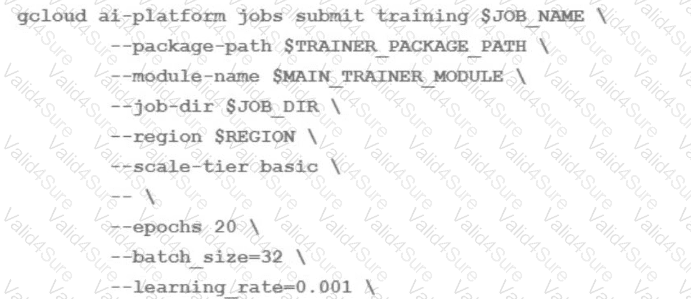
You want to ensure that training time is minimized without significantly compromising the accuracy of your model. What should you do?

A.

Modify the ' epochs ' parameter

B.

Modify the ' scale-tier ' parameter

C.

Modify the batch size ' parameter

D.

Modify the ' learning rate ' parameter

Full Access
Question # 38

You are using Keras and TensorFlow to develop a fraud detection model Records of customer transactions are stored in a large table in BigQuery. You need to preprocess these records in a cost-effective and efficient way before you use them to train the model. The trained model will be used to perform batch inference in BigQuery. How should you implement the preprocessing workflow?

A.

Implement a preprocessing pipeline by using Apache Spark, and run the pipeline on Dataproc Save the preprocessed data as CSV files in a Cloud Storage bucket.

B.

Load the data into a pandas DataFrame Implement the preprocessing steps using panda’s transformations. and train the model directly on the DataFrame.

C.

Perform preprocessing in BigQuery by using SQL Use the BigQueryClient in TensorFlow to read the data directly from BigQuery.

D.

Implement a preprocessing pipeline by using Apache Beam, and run the pipeline on Dataflow Save the preprocessed data as CSV files in a Cloud Storage bucket.

Full Access
Question # 39

You have deployed a model on Vertex AI for real-time inference. During an online prediction request, you get an “Out of Memory” error. What should you do?

A.

Use batch prediction mode instead of online mode.

B.

Send the request again with a smaller batch of instances.

C.

Use base64 to encode your data before using it for prediction.

D.

Apply for a quota increase for the number of prediction requests.

Full Access
Question # 40

You are training a TensorFlow model on a structured data set with 100 billion records stored in several CSV files. You need to improve the input/output execution performance. What should you do?

A.

Load the data into BigQuery and read the data from BigQuery.

B.

Load the data into Cloud Bigtable, and read the data from Bigtable

C.

Convert the CSV files into shards of TFRecords, and store the data in Cloud Storage

D.

Convert the CSV files into shards of TFRecords, and store the data in the Hadoop Distributed File System (HDFS)

Full Access
Go to page: